
And the stories that the ceiling told
Through the pictures and the grains in the pine-wood boards
And I could stay outside ’til the sky went red
And I could cool my head on the concrete stepsAnd you could never really see the top from the bottom
I don’t pay enough attention to the good things when I got ’em
And you could never really see the top from the bottom
I don’t pay enough attention to the good things when I got ’emI don’t pay enough attention to the good things when I got ’em
I don’t pay enough attention to the good things when I got ’em
I don’t pay enough attention to the good things when I got ’em
I don’t pay enough attention to the good things when I got ’em, noJosh Pyke. Middle of the Hill.
The rock surface beneath my fingers feels coarse. Cold. Rough to the touch. I move the palms of my hands over the surface of the rocky plateau beneath me. Single grains of sandstone come loose and linger on my fingertips. I am Country.
I am also the teacher. And so I open my eyes to check on my students. 19 little bodies lying on their backs, spread out on a stone platform in the middle of the bush. 19 little pairs of eyes closed, 19 arms and legs stretched out peacefully. 19 mouths quiet. 19 little people are Country.
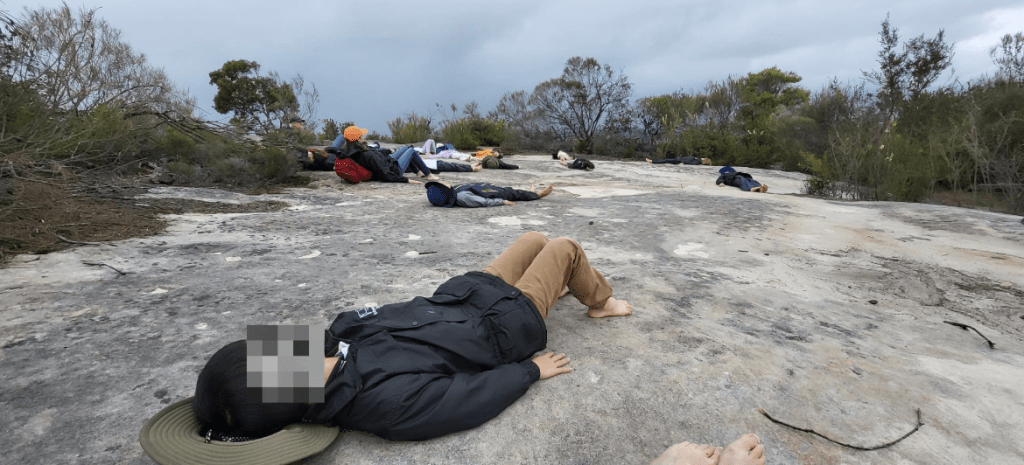
And so I close my eyes again. Hear the wind in the dry eucalyptus trees. The roar of the ocean beneath us. A crow cawing impatiently as if to get us moving again – but not so fast. 19 little people resting peacefully on a giant slap of sandstone doesn’t happen every day. Actually never.
One eye on the kids, the other closed, I feel the ochre paint on my face slowly drying on my face. A light drizzle is starting to fall on my skin, not enough to wash the soft sandstone markings away. The Country underneath us. The Country on us. For a sweet little moment, we become a landscape within the landscape. 19 little tiny blips surrounded by the vast country of one the oldest living cultures on Earth. Country is alive. Country is timeless. Country is us.
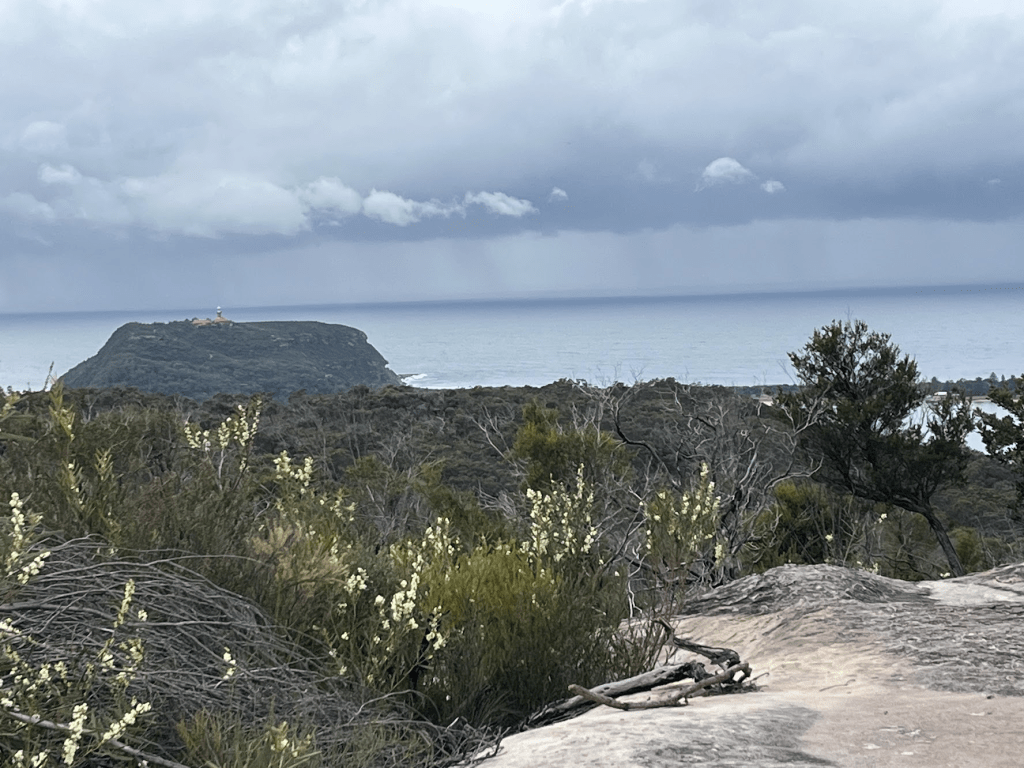
Until it isn’t. I think one of the kids starts laughing. Another follows with a giggle. Some jump up, glad to get off the uncomfortable hard ground. Others keep their eyes closed, obviously enjoying this moment of rest. It has been a long day. A day in the Australian bush with my year 1/2 class. After exploring local plants and animals, rocks and minerals in the classroom, we jump on the school bus and drive through the Ku-ring-gai National Park that surrounds our school, to get to the iconic West Head Lookout. Twenty minutes from school, a little under an hour from the hustle and bustle of the Sydney CBD, we are in the middle of the Australian bush, the land of the Garrigal people, and home to one of the largest known concentration of recorded Aboriginal sites in Australia. The Ku-ring-gai National Park has at least 1000 sites of significance to the Aboriginal culture.

In his short story “Laugh, Kookaburra”, the American author David Sedaris states “For an American, though, Australia seems pretty familiar: same wide streets, same office towers. It’s Canada in a thong, or that’s the initial impression…To see the country, you have to see the country_side”. Countryside means bush. “When Australians say “the bush,” they mean the woods. The forest.
And so here we are: In the Australian forest, err bush, surrounded by wintery heathland and endless eucalyptus forest. Tiny yellow wattle flowers in bloom as if to remind us that this was indeed Australia.
The children get to collect different leaves and sort them: plain and patterned, broken and intact, brown and green. Next, each child had to collect an animal that was small enough to fit into a little plastic container. A task that seemed impossible at first looking at the winter bush around us. Until children started to look under branches and logs and found all kinds of creepy crawlers: ants and centipedes, insects and spiders. A very focused and reflective exercise until my team teacher screamed: Funnel-web spider! And jumped what must have been a new Australian record, including the impressive jump of the local wallabies.

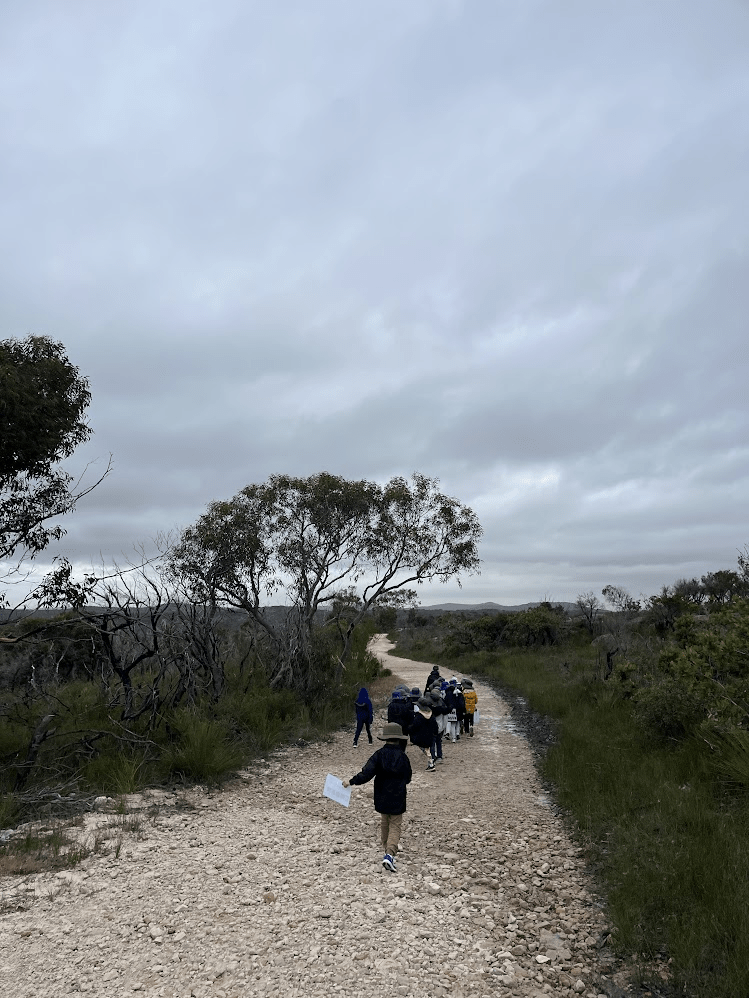
A walk through the bush followed, a winding sandy gravel path past yellow sunshine wattle bushes, and banksia trees. Black-bottomed grass trees and scribbly gum trees. Until we reach the Engraving Site. Prompted by our guide Helen, we take off our shoes and socks – on a wet and cold Sydney winter day not a pleasant task but we do as we are told out of respect. Helen takes a little stone mortar out of her backpack and grinds some white ochre. Mixes it with water from her drink bottle and starts anointing the children and us teachers, on the face – to see, on our hands – to feel, and on our feet – to walk with respect.
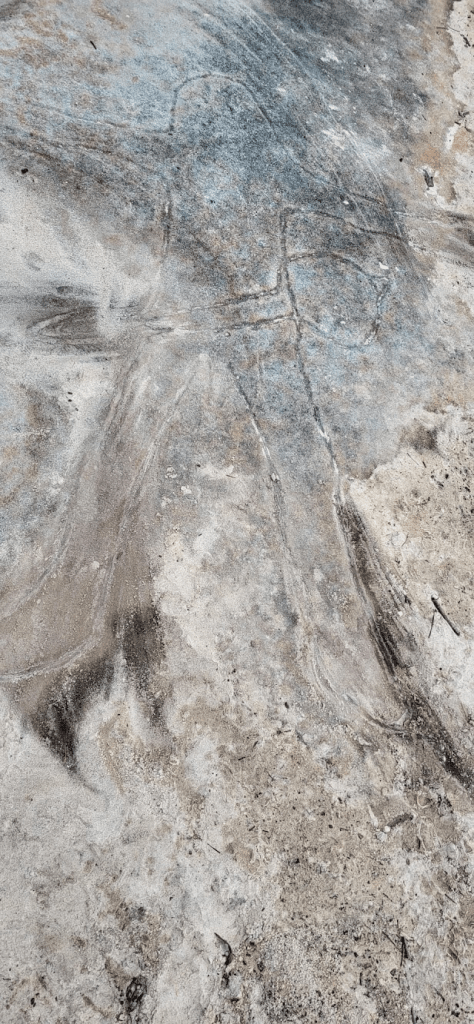
As the ochre dries, I can feel the elements on my face. The connection to Country. We follow Helen onto the engraving site and soon we discover figures carved into the grand, flat sandstones over 5000 years ago. There are engravings of wallabies, fish, eels, hunting tools, and echidnaes. The recent rain pools in the grooves clearly outline the shapes giving clarity to their carvings. We are paying homage to the carver-crafters who, thousands of years ago, knelt at this community site with their stone tools and etched their natural and spiritual lives on this rocky canvas.
Bulgandry is the name given to the ancestral hero depicted here whose engraving is the most spectacular aspect of this site. It’s the story of Biayami, the father and creator in the Dreamtime legend. Carved into the rock, he stands with his arms outstretched, the sun’s rays beaming from his head. The children smile a knowing smile – Bayame was, after all, the main character in the play they were going to perform the following week to their parts as part of their learning. As their teacher, I feel a mix of pride and fear of being scolded for cultural misappropriation wash over me. That, or it had finally started to rain.
In a time where it is not always easy for me to decide what home is or should be, the teachings of the Aboriginal people make me think. Rather than viewing the country as a physical environment, they consider Country as a “deeply symbolic and spiritual place”.
“Country is alive. Country is timeless. And Country is us. Our idea of home is Country. Country is a place. Country is relationship.”
Lying there on the cold, hard sacred ground, I suddenly realize my backpack is sitting on a pile of fresh wallaby poo. Surrounded by my students and colleagues who have become friends, I can’t help but chuckle at the absurdity and beauty of the moment. This, too, is Country. The ochre paint under my eyes has helped me see, just as our guide Helen said it would. I see Country, in all its messy, wonderful glory.


 Thoughts From the Upside Down
It is a dream job what you’ve been doing in the last 2 years! I don’t even know how you’ll be able to come back to the boring job here.
LikeLiked by 1 person
Dankeschön, liebe Gisela! Deine Students werden sich bestimmt noch lange an diesen Ausflug und die Zeit mit Dir erinnern. Du hast sicher Unvergessliches bewirkt Upside Down. Danke für Deine Thoughts von dort!
Von meinem iPhone gesendet
>
LikeLiked by 1 person